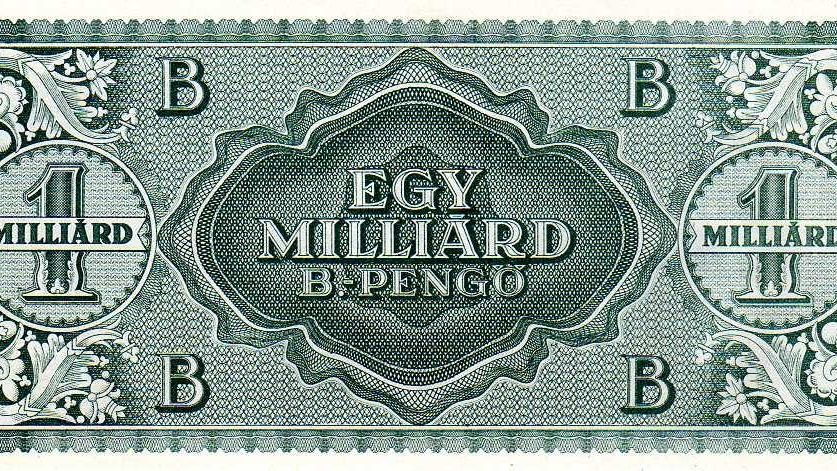
 Image: Magyar Nemzeti Bank (Hungarian National Bank), public domain
Why prices in Hungary doubled every fifteen hours
The banknote at the top of this page promises to pay one milliard B-pengő. A milliard is a thousand million and a B-pengő is a million million pengő, so the note is for 1021 pengő, a one followed by twenty-one zeros. It was printed in Hungary in the summer of 1946 and never issued, because by the time it was ready the currency had been abolished. The largest note that did circulate, for one hundred million B-pengő, was worth about 20 US cents on the day it appeared and less by the evening.
The record
The economists Steve Hanke and Nicholas Krus assembled a table of every hyperinflation for which monthly data exist, 56 episodes in all, and published it in 2012 as a working paper of the Cato Institute. They used the definition proposed by Phillip Cagan in 1956: a hyperinflation begins in the month in which prices rise by more than 50 per cent and ends when the monthly rate has stayed below that for a year. Hungary's episode ran from August 1945 to July 1946, and in its final month prices rose by a factor of about 4 × 10¹⁶, that is, the monthly inflation rate was about 41,900,000,000,000,000 per cent. The corresponding daily rate was about 207 per cent, which means that something that cost 100 pengő at breakfast cost 307 pengő at breakfast the next day. Zimbabwe in November 2008 is second on the list with a daily rate of 98 per cent, and Germany in October 1923, the episode everybody has heard of, is fifth with about 21 per cent a day.
From a daily rate to a doubling time
A daily rate of 207 per cent sounds like tripling every day, and that is what it is: the price at the end of the day is 3.07 times the price at the start. The doubling time follows from the same arithmetic that Unit 1 of the masterclass uses for the growth of an economy. If prices multiply by 3.07 in 24 hours, then after a time t in hours they have multiplied by 3.07 raised to the power t/24. Setting that equal to 2 and taking natural logarithms gives t = 24 × ln 2 / ln 3.07 = 24 × 0.693 / 1.122, which is 14.8 hours. Prices doubled roughly every fifteen hours, twice in a day and a half, and about 48 times during July. The rule of 70 that works so well for growth rates of a few per cent is useless here, because it is an approximation for small rates; the exact formula with logarithms is the one to use once a rate is large.
In a hyperinflation the index that Unit 7 describes is nearly impossible to compile in the ordinary way, because prices change between the morning and afternoon visits of the price collector. The Hungarian numbers come from the exchange rate of the pengő against gold and the dollar on the black market and from a small set of goods priced daily, which is why the figures are given as approximate even in the best sources.
How it happened
Hungary ended the Second World War on the losing side. Budapest had been besieged for fifty days, about 40 per cent of the national wealth had been destroyed, the Soviet army was requisitioning food and equipment, and the country owed reparations that took a large share of what remained of its output. Tax revenue had collapsed with the economy. The government paid for its spending, for reconstruction, and for the reparations by having the central bank print money, which is the mechanism behind every hyperinflation in the Hanke and Krus table, and which the quantity equation of Unit 9 describes: when the money stock grows far faster than output, the price level must follow.
Two features made the Hungarian case the extreme one. First, the government printed money and also indexed its own spending to the rising prices while taxes lagged behind, so the deficit grew with the inflation it caused. Second, in January 1946 the authorities introduced a parallel unit of account, the tax pengő or adópengő, whose value was adjusted daily to the price index. It was meant to protect tax revenue and bank deposits from inflation, and it did, but once businesses started quoting prices and signing contracts in adópengő, the ordinary pengő lost its last function as a measure of value, and the rate at which people tried to get rid of it exploded. By July the velocity of circulation, the number of times a note changed hands, had become the main driver of prices rather than the printing itself.
How it ended
The end was abrupt, as the end of a hyperinflation usually is. On 1 August 1946 the government introduced a new currency, the forint, at a rate of 400,000 quadrillion pengő to one forint, that is 4 × 1029. The number is less interesting than what came with it. The new central bank law restricted the issue of forints, the budget was brought close to balance with new taxes and cuts, the reparations schedule had been eased, and the country had received back its gold reserve, which the retreating German army had taken and the United States returned. Prices stabilized within weeks. Thomas Sargent argued in a famous essay on the ends of four earlier hyperinflations that what stops one is a credible change in the fiscal regime rather than the new note itself, and Hungary fits his account. People accepted the forint because they believed the government would no longer need to print it.
What a student should take away
The first point is arithmetic. Percentages compound, and once rates are large the compounding dominates everything, which is why a daily rate of 207 per cent produces a monthly rate with sixteen zeros. The second point is about money. Inflation on this scale is always a monetary event in the sense that the money stock grew without limit, and it is always a fiscal event in the sense that the money was printed to cover a deficit that nothing else could cover; the two statements are the same statement from two sides, and Unit 9 of the masterclass sets them out with the quantity equation and the Fisher equation. The third point is about measurement. The 207 per cent is an estimate built from exchange rates and a few prices, and it is quoted as about 207 per cent for that reason. A number without its method is a number you cannot judge.
The Hungarian record has held for eighty years. It is one of the numbers worth knowing that the masterclass collects on its key models page alongside the equations, and the banknote in the picture is the clearest illustration of what the quantity equation looks like when it is pushed to the limit.