
Economics Masterclass12-Week Program in Economics
Study how markets set prices and why some countries grew rich, one unit per week, with real data and the research of economists who are working today.
- Certificate
- Online
- Join a community of 3500+

Source: NASA, photograph by an Expedition 38 crew member on the International Space Station, 2014, public domain, via Wikimedia Commons. Labels added.

Twelve weeks with the economy
The Economics Masterclass takes you through economics one unit at a time. You enrol, and from then on a new unit reaches you every week. Each unit is a chapter written for this program, with worked examples, real data from statistical offices and central banks, and the published research of economists who are active today.
A quiz completes every unit and opens the next. At the end you sit a final exam and receive a certificate with a public verification page.
Key points
- Structured. A fixed sequence of units that starts with supply and demand and ends with the questions economists are arguing about now.
- Demanding and fair. Each model comes as a graph and an equation, and is then checked against real numbers step by step.
- Recognized. A certificate and a transcript, both with a verification ID that anyone can check online.

Source: plate on pin-making from Diderot and d'Alembert's Encyclopédie, 1762, designed by Goussier and engraved by Defehrt, public domain, via Wikimedia Commons. In The Wealth of Nations (1776) Adam Smith describes ten such workers making upwards of 48,000 pins a day.

Who the program is for
| High School Students | University Students | Lifelong Learners |
|---|---|---|
You follow the news about inflation and interest rates and want to know what is behind it. The masterclass prepares you for an economics degree and for the International Economics Olympiad.
|
A supplement to a degree in economics, business, politics, or engineering, with the models behind the headlines worked out in full. Use it to prepare for intermediate courses or a first project.
|
You run a business, invest your savings, or wonder why prices rise and why some countries are rich. The masterclass explains the economy step by step, with the graphs and numbers economists use.
|
| School mathematics is enough | Models with full derivations | No deadlines, pause any time |
| Certificate for applications | Current research papers | Unit 1 refreshes the mathematics |
| Theory for olympiads and essay prizes | A weekly data tool of the field | Read on screen or as PDF |
Preparing for an olympiad? Economics Olympiad Preparation shows which units cover which olympiad topics.
How it works
- 1
Enrol
Week 0
Create your account with your email address, choose your masterclass, and pay the Tuition Fee. Your program starts at once.
- 2
Receive your unit
Unit 1 at once, then every Monday
Unit 1 arrives immediately and every further unit on a Monday, as a web page and as a PDF to keep.
- 3
Study
During the week
Work through the models, the worked examples, and the data, and answer the questions in the text as you go. A day later we send further reading, including research papers that are free to read.
- 4
Take a quiz for every unit
Before the next unit
Each unit has its own quiz: ten questions, open book, no time limit. You submit it before the next unit is sent to you.
- 5
Sit the final exam
After the last unit
50 questions across the units of your masterclass in 60 minutes, open book. You pass with 70% and have up to 3 attempts.
- 6
Earn your certificate
When you pass
Certificate and transcript as PDF, each with a verification ID and a personal link you can share.
Source: Economics Masterclass program rules. A unit can also be requested early, 24 hours after the previous one, once its quiz is submitted.
Topics
16 units in three groups. Foundation covers the first 8, Advanced the first 12, and Advanced + Behavioural Economics all 16.

Source: Joe deSousa, CC0, via Wikimedia Commons.

Units 1 to 8: Markets and Nations
How economists think and test their ideas, how buyers and sellers set a price, what firms do with competition and with market power, when markets fail, how the economy is measured, and why some countries grew rich while others did not.

Source: Associated Press, public domain, via Wikimedia Commons.

Units 9 to 12: Money, Cycles, and Trade
How banks create money and central banks set interest rates, what causes recessions and what governments can do about them, why countries trade, and what decides wages and the gaps between them.

Source: Jan Brueghel the Younger, public domain, via Wikimedia Commons.

Units 13 to 16: Behavioural Economics
The shortcuts and biases of real decisions, why a loss hurts more than an equal gain pleases, why we save too little and how defaults change that, and how crowds of investors build bubbles.
Source: Economics Masterclass curriculum. Weeks count from enrolment; bars in the lighter tint are the units of the Advanced + Behavioural Economics masterclass only. Select a unit to read its summary.
Tuition Fee
Three masterclasses, each a complete program with its own final exam and certificate. The Tuition Fee is paid once.
| Foundation | RecommendedAdvanced | Advanced + Behavioural Economics | |
|---|---|---|---|
| What it covers | The fundamentals of economics: markets, firms, market failure, and the measurement and growth of the economy. | The full program, with money and central banks, business cycles, trade, and labour markets. | The full program plus four units on behavioural economics and its research. |
| Units, as web pages and PDFs | 1 to 8 | 1 to 12 | 1 to 16 |
| Weeks | 8 | 12 | 16 |
| Weekly unit quizzes | 8 | 12 | 16 |
| Further reading and a key results email every week | Included | Included | Included |
| A tool of the field each week, such as FRED or Our World in Data | Included | Included | Included |
| Final exam | 50 questions | 50 questions | 50 questions |
| Certificate and transcript | Included | Included | Included |
| Former Tuition Fee | |||
| Tuition Fee | $35 | $55 | $85 |
| Choose Foundation | Choose Advanced | Choose Advanced + Behavioural Economics |
Foundation
The fundamentals of economics: markets, firms, market failure, and the measurement and growth of the economy.
- Units
- 1 to 8
- Weeks
- 8
- Unit quizzes
- 8
- Final exam
- 50 questions
- Certificate and transcript
- Included
$39 $35
Recommended
Advanced
The full program, with money and central banks, business cycles, trade, and labour markets.
- Units
- 1 to 12
- Weeks
- 12
- Unit quizzes
- 12
- Final exam
- 50 questions
- Certificate and transcript
- Included
$69 $55
Advanced + Behavioural Economics
The full program plus four units on behavioural economics and its research.
- Units
- 1 to 16
- Weeks
- 16
- Unit quizzes
- 16
- Final exam
- 50 questions
- Certificate and transcript
- Included
$119 $85
Every masterclass includes further reading and a key results email every week, and a tool of the field each week, such as FRED or Our World in Data.
Tuition fees are one-time payments and include applicable taxes. Secure payment by card through Stripe.
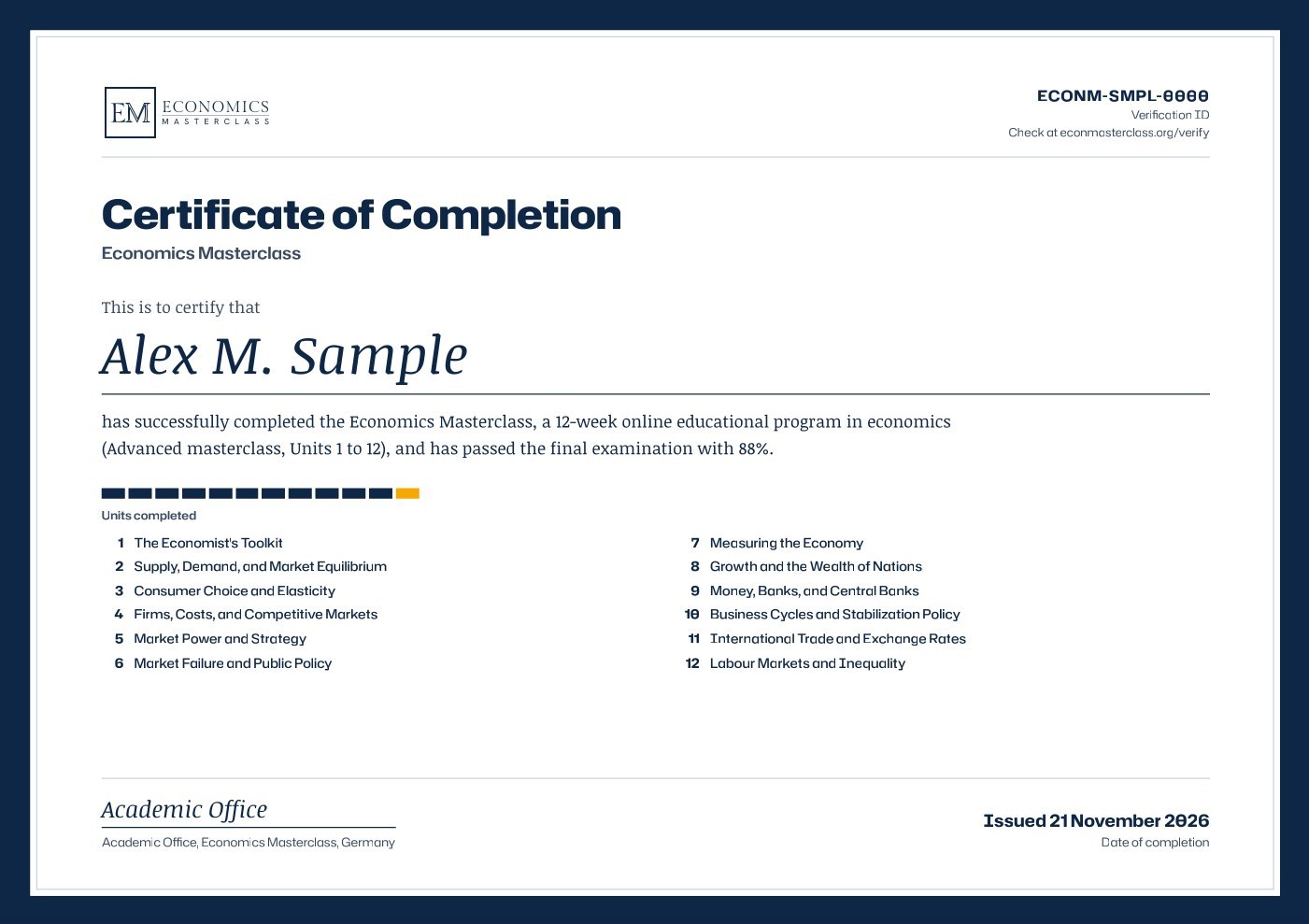
Your certificate
Participants who pass the final exam receive an official certificate of completion. It states your name, the masterclass, its duration, and the units you completed.
- Certificate and transcript. The transcript lists your score in every unit quiz and in the final exam.
- Verifiable. Both documents carry a verification ID that can be checked on this website.
- Shareable. Your personal verification link shows your result to universities, scholarship committees, and employers.
Sample unit
Unit 2. Supply, Demand, and Market Equilibrium
How buyers and sellers arrive at a price and a quantity, and what moves both when a frost, a tax, or a rent cap hits the market. The unit builds the market diagram from two straight lines, solves it, follows the coffee price through the Brazilian frost of 2021, works out who really pays a petrol tax, and ends with the trades society refuses to price, such as kidneys. 15 pages.
Questions the unit answers
- Why does the price of a good rise when demand increases and supply stays the same, and why does the quantity rise with it?
- What is the difference between a change in demand and a change in the quantity demanded, and how do I draw each?
- How do I find the equilibrium price and quantity from two straight-line equations, and what do I check afterwards?
- When a government taxes petrol, who pays the tax in the end, and what decides the split between buyers and sellers?
- What happens in a market when the government sets a maximum price below the equilibrium price, and who gains?
- Why are some things not allowed to have a price at all, and what does a market designer do instead?
On most mornings at Toyosu market in Tokyo, buyers walk along rows of frozen tuna, shine a torch on a small cut of flesh near each tail, and decide what each fish is worth to them. A few minutes later an auctioneer sells the fish one by one to the highest bidder. Nobody in the hall fixes the price in advance, yet by the end of the auction every fish has one, and the prices reflect how many fish arrived that night and how many restaurants want them. This unit explains how the same thing happens in every market, with two curves and the point where they cross, and what moves that point when a frost, a tax, or a law hits the market.


Academic community
Masterclass participants come from all over the world, and when you complete the program you stay part of a network that keeps you close to economics.
| Economists in our community | 3500+ |
|---|---|
| Countries represented | 90+ |
| Schools and universities represented | 750+ |
Source: Economics Masterclass, 2026.
Econ-Connect
Our alumni program introduces former participants to one another across countries: for study advice, exchange about university applications, and shared projects.
Opportunities
Past participants hear from us about scholarships, competitions, summer schools, and other academic opportunities in economics.
A place in economics
The program shows you how economic research is done and where it happens, so that your next step at school, at university, or at work is an informed one.
Further reading from the blog
What you can do with an economics degree
Most economics graduates never work as economists, and the data show they do well anyway. The jobs they take, the skills employers are paying for, what the published earnings figures say, and how to keep the research path open if you want it.
Why the stock market moves more than it should
If share prices were the market's best forecast of future dividends, they would move only when the forecast changed. In 1981 Robert Shiller showed that prices move far more than the dividends that followed could justify. The argument, the chart, and what the price-earnings ratio has predicted since.
How to read an economics paper as a beginner
Research papers in economics are written for other researchers, and a beginner who starts at page one and reads to the end usually gives up around page four. There is a better order, and a few questions to ask of every paper. A walk through one open article as the example.
Frequently asked questions
Who is this program for?
For high school students, university students, and lifelong learners. High school students use it to understand the news about inflation, tariffs, and interest rates, to get ahead before a degree in economics, business, or politics, and to prepare for economics olympiads and essay competitions. University students in economics, business, politics, engineering, or data science take it next to their degree, before an intermediate course or a first research project. Lifelong learners, among them people who run a business, invest their savings, or work in a bank or a ministry, use it to see the models behind what they do every day. The Foundation masterclass suits a first contact with the subject; the Advanced masterclass goes on to money and central banks, business cycles, trade, and labour markets.
What do I need to know before I start?
School mathematics is enough: percentages, ratios, the slope of a straight line, simple simultaneous equations, and reading a value from a graph. You do not need any prior knowledge of economics, finance, or history. Unit 1 teaches every tool the later units use, including growth rates and the rule of 70, real against nominal values, index numbers, logarithms as far as a log scale needs them, and the difference between a correlation and a cause. From Unit 9 on, a derivative may appear inside a box marked as a derivation, with every step explained in words; the main text never depends on it. No unit requires a spreadsheet, a programming language, or a particular calculator.
How much time do I need each week, and are there live sessions?
Most participants spend three to five hours a week: two or three hours on the unit, under an hour on the open-book quiz, and the rest on the further reading if they want it. Units with long worked examples, such as the one on business cycles, take more if you redo the calculations yourself, which we recommend. The program is fully online and has no live sessions, so it works in every time zone and next to school, university, or work. You receive the units by email and read them on the website or as PDF. Quizzes and the final exam are taken on the website.
Can I finish the program in less than 12 weeks?
Yes. A new unit is scheduled for every Monday, but once you have submitted the quiz of a unit you can ask for the next one ahead of schedule, from your dashboard or from the email we send you. The earliest moment is 24 hours after the previous unit was sent. We recommend the weekly rhythm, because the material needs time to settle, but the pace is your decision.
What happens if I fall behind or have to pause?
Nothing is lost. The next unit is only sent once you have submitted the quiz of the current one, so the program waits for you. You can pause for a week or for a term and continue at any time. There is no penalty and no deadline.
How does the final exam work?
After the last unit you sit the final exam online: 50 multiple-choice questions across all units of your masterclass, drawn individually for each participant, with a time limit of 60 minutes. It is open book. You pass with 70% correct answers. If you do not pass, you can try again after 3 days with new questions, up to 3 attempts in total.