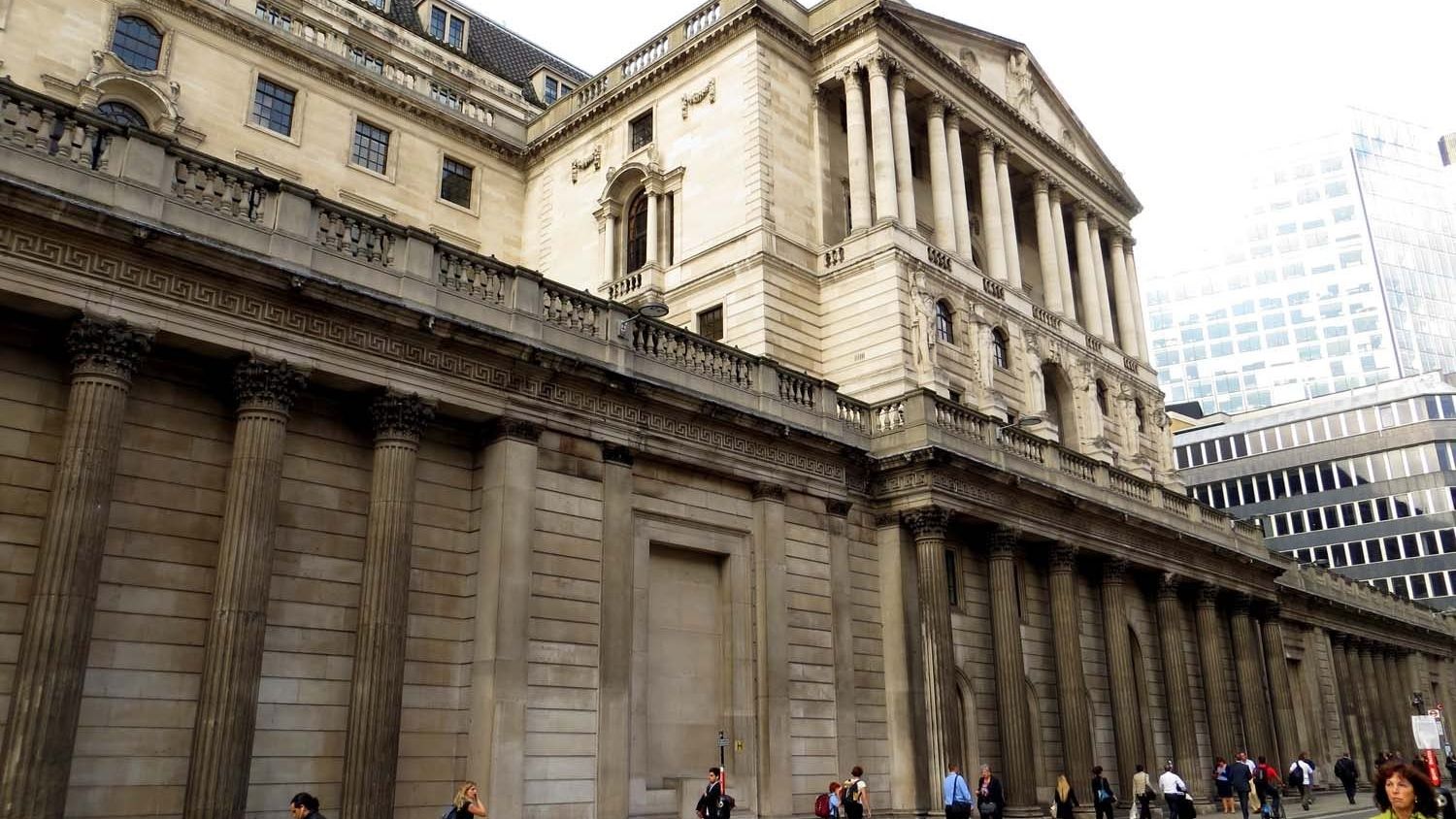
 Image: Lee Jordan, CC BY-SA 2.0
What a run on a bank looks like, 1866 to 2023
On Thursday 9 March 2023 the depositors of Silicon Valley Bank, a Californian bank with about 200 billion dollars of assets, tried to withdraw 42 billion dollars in a single day, most of it by phone. The next morning the California regulator closed the bank and handed it to the Federal Deposit Insurance Corporation, whose press release is two paragraphs long. It was the second largest bank failure in American history, and it took about 36 hours from the first alarm to the end.
1866
The oldest case in this story moved at the speed of a hansom cab. Overend, Gurney and Company was a discount house in Lombard Street, the largest in London, which lent to merchants against bills of exchange and borrowed from the public and from other banks at short notice. In the early 1860s it moved into riskier lending, including shipping and railways, and lost money; it converted into a limited company in 1865 to raise fresh capital and kept the losses quiet. When a court ruling in May 1866 cast doubt on the value of a class of bills, depositors came for their money, and on 10 May the firm suspended payments with liabilities of about 11 million pounds, of the order of 1.3 billion pounds in today's money by the consumer price index. The next day, known as Black Friday, crowds filled Lombard Street, and the panic spread to banks that had done nothing wrong. The Bank of England lent heavily to the sound ones, against good security and at a penalty rate of 10 per cent, and the panic subsided within a week. The Bank of England's own account, published 150 years later, is worth reading for the detail. Walter Bagehot wrote up the episode in Lombard Street in 1873, and his rule for a central bank in a panic, to lend freely at a high rate against good collateral, is still quoted by central bankers as if it were new.
2007
Northern Rock was a mortgage lender in Newcastle that had grown fast by funding long-term mortgages with short-term borrowing in the wholesale markets rather than with deposits. When those markets froze in August 2007, after losses on American subprime mortgages, the bank could not roll over its borrowing. It asked the Bank of England for emergency support, and on the evening of Thursday 13 September the BBC reported the request. On Friday morning queues formed outside the branches, the photograph at the top of this page among them, and over three days depositors withdrew about 2 billion pounds, roughly one twelfth of the bank's retail deposits. The run stopped on Monday 17 September when the Chancellor of the Exchequer announced that the government would guarantee every deposit. The bank was nationalized in February 2008. It was the first run on a British bank since 1866, and it happened to a bank whose mortgages were, at the time, performing normally.
2023
Silicon Valley Bank's deposits had tripled between 2019 and 2021 as its customers, technology start-ups and their investors, raised money faster than they could spend it. The bank put much of the inflow into long-dated government and mortgage bonds, which are safe in the sense that they will be repaid and unsafe in the sense that their price falls when interest rates rise. Rates rose by more than 4 percentage points in 2022, and by the end of that year the bank's securities had lost about 15 billion dollars of market value on paper, which was close to its entire equity of about 16 billion. The arithmetic is the present value formula of Unit 9: a ten-year bond paying 1.5 per cent is worth about 20 per cent less when yields rise to 4 per cent. On 8 March 2023 the bank announced it had sold some bonds at a loss and needed to raise capital. Its depositors, who talked to each other on group chats and most of whom held far more than the insured limit of 250,000 dollars, drew the obvious conclusion and acted on it by the next afternoon.
The one idea
Douglas Diamond and Philip Dybvig published the model that connects these three episodes in 1983, and shared the 2022 Nobel prize in economic sciences for it with Ben Bernanke. A bank takes deposits that can be withdrawn at any time and uses them to make loans or buy assets that pay off over years. This is useful: savers get liquidity and borrowers get long-term funding, and the arrangement works because on a normal day only a small fraction of depositors want their money. It is also fragile, because the bank cannot pay everyone at once without selling its long assets at a loss, and if depositors believe the others are about to withdraw, each of them is right to withdraw first. There are two equilibria. In one, nobody runs and the bank is sound. In the other, everybody runs and the bank fails, and the bank can be perfectly solvent in the first and still fail in the second. What tips the system from one to the other can be bad news, as at Overend Gurney and Silicon Valley Bank, or a television report, as at Northern Rock, or nothing at all. Diamond's own short exposition of the model is the research spotlight of Unit 9 and needs no mathematics beyond arithmetic.
The model also says what stops runs. If depositors know they will be paid in full whatever happens, there is no reason to be first in the queue, so a credible deposit guarantee removes the bad equilibrium without ever being used. The United States introduced deposit insurance in 1934, after the runs of the Depression closed thousands of banks, and Britain's guarantee of September 2007 ended the Northern Rock run overnight. The other remedy is Bagehot's: a central bank that lends to solvent banks against their good assets, so that a bank need not sell at a loss to pay its depositors. Both remedies have a cost, which is that a bank that knows it will be rescued may take more risk, and the regulation of banks' capital and liquidity exists to limit that.
A worked number
Take a bank with 100 million euros of deposits, 10 million in reserves, and 90 million in loans and bonds that can be sold today only at 85 per cent of their value. Withdrawals of 5 per cent are met from reserves. Withdrawals of 10 per cent exhaust the reserves. Withdrawals of 20 per cent force the sale of about 11.8 million euros of assets to raise the missing 10 million, which costs 1.8 million in losses; the bank survives if its equity exceeds that. Withdrawals of 50 per cent force the sale of 47 million of assets and a loss of 7 million, which wipes out the equity of most banks. Every depositor who understands this table wants to be among the first 5 per cent, and that is the run.
Silicon Valley Bank's depositors were uninsured above 250,000 dollars, well informed, and connected to each other, which is why its run was the fastest on record. The FDIC guaranteed all of its deposits two days later to stop the run spreading to similar banks. Unit 9 of the masterclass, Money, Banks, and Central Banks, builds the balance sheet, follows the three cases, and explains why the deposits a bank creates when it lends are also the thing that can destroy it.