

Measuring the Economy
Gross domestic product, the price indices, and the unemployment rate are the three measurements on which every macroeconomic argument rests. This unit shows how statistical offices build them: the three ways of counting GDP, the deflator and purchasing power parity, the basket behind a consumer price index and why it overstates the cost of living, the definitions behind the unemployment rate, and why the first published figure is revised. It also asks what GDP leaves out and what its inventor said about it.
On the morning of 8 May 2020 the Bureau of Labor Statistics announced that 23.1 million Americans were unemployed, which was 14.7 per cent of the labour force and the highest rate since the monthly series began in 1948. The number did not come from a count of the unemployed, because nobody counts them; it came from interviews with about 60,000 households and a set of definitions written down decades earlier, and a year later the same office said the rate had really been 14.8 per cent. Every argument about recessions, inflation, and growth rests on numbers of this kind, so this unit looks at how they are made: what a statistical office counts when it measures output, prices, and jobs, what it leaves out, and how far the first published figure can be trusted.
1 Counting a nation’s output
Until the 1930s no government knew how large its economy was. When the Great Depression (1929 to 1939) began, nobody could say by how much the income of the United States had fallen, until the economist Simon Kuznets (1901-1985) delivered the report National Income, 1929-32 in January 1934; the excursion in Section 3 tells the story. The system of accounts that grew out of it is what every country uses today, and its central number is GDP.
Gross domestic product (GDP) is the market value of all final goods and services produced within a country during a given span of time, usually a year or a quarter. Each part of the definition has a purpose. Market value means that goods are added up at the prices they sell for, so that a tonne of steel and an hour of legal advice can enter the same sum. Final means goods bought by their last user, and it excludes intermediate goods, which are bought to be used up in making something else. For example, if a farmer sells wheat to a mill for 20 cents, the mill sells the flour to a baker for 50 cents, and the baker sells the loaf to a customer for 2.50 euros, GDP rises by 2.50 euros, which is the value of the final loaf, and not by 3.20 euros, which would count the wheat three times. Produced means made during the year in question, so the sale of a twenty-year-old house or a second-hand car adds nothing to GDP, although the estate agent’s or dealer’s fee does, because that service is new. Within a country means on its territory, whoever owns the factory; the related measure gross national income (GNI) adds the income residents earn abroad and subtracts what foreigners earn at home, and the two differ by only one or two per cent, except in countries where many firms are foreign-owned, such as Ireland.
1.1 Three ways to the same number
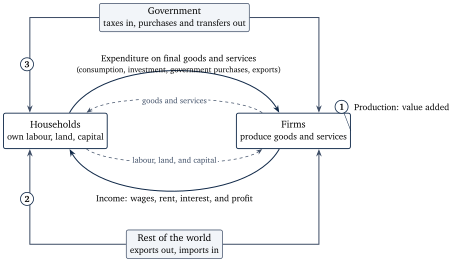
Figure 1 shows the circular flow of income that Unit 1 introduced, now with the government and the rest of the world added, and with three points marked at which the flow can be measured. Firms produce goods and services, households buy them, and the money firms receive goes out again as wages, rent, interest, and profit. Because every sale is at the same time somebody’s spending and somebody’s revenue, the flow can be measured at any of the three points and must give the same total.
The expenditure approach is the one the news quotes, because its parts answer the question of who is doing the spending. Economists write it as an identity, which is an equation that is true by definition, with letters that the rest of this unit and Unit 8 use.