

Money, Banks, and Central Banks
Most of the money in a modern economy is a promise written in a bank's books, and this unit explains how those promises are created, priced, and kept. It covers the functions of money, present value and bond prices, how a loan creates a deposit, why a sound bank can fail in a run and what stops it, how central banks set interest rates and why they were made independent, and what money growth does to inflation over decades.
On the morning of Thursday 9 March 2023, the customers of Silicon Valley Bank in California tried to move 42 billion US dollars out of their accounts, about a quarter of everything the bank held for them, without a queue in sight. The bank had not lost its money on bad loans. It owned government bonds and mortgage securities that would have paid in full if held to the end. By Friday morning it was closed. The story rests on the three ideas of this unit: that money today is mostly a promise written in a bank’s books, that a promise to pay later is worth less when interest rates rise, and that a bank which has promised everyone their money at once can keep the promise only as long as nobody tries it. The unit ends with the central banks, the institutions built to keep such promises credible, and with what they can and cannot do about inflation.
1 What money is
Economists define money by what it does rather than by what it is made of. Money is anything that is generally accepted in payment for goods, services, and debts. Cowrie shells, silver coins, paper notes, and the figures in a bank account have all served, and the shells served well as long as everyone in the region took them. The definition contains three jobs, which economists list as the functions of money.
The first function is the one that defines money, because many things store value (a house, a share, a bar of gold) without being accepted at a shop counter. An asset that can be turned into cash quickly and without loss is called liquid. Cash is perfectly liquid, a government bond can be sold within minutes at a known price, and a house takes months to sell and may sell for less in a hurry.
Money has taken two forms. Commodity money is a good with a use of its own that also circulates in payment, such as gold or silver coin, and its value rests on the metal. Fiat money has no use except as money, and the notes in a wallet today are of this kind. A 20 euro note costs a few cents to print and buys a meal, and it holds its value for three reasons that reinforce one another. First, shops and employers accept it because they can pass it on, which is a convention that sustains itself as long as it is shared. Second, taxes must be paid in it, so there is always a reason to want it. Third, the central bank that issues it limits the quantity, so that it stays scarce. The third reason is the one that fails in a hyperinflation, which Section 6 returns to, and when it fails the first fails with it. For example, in Hungary in 1946, when prices were doubling about every 15 hours, people stopped accepting the pengő, the Hungarian currency of the time, and traded in goods and foreign currency instead.
Most money today is neither coin nor note. When a shop is paid by card, no banknote moves; the bank of the buyer reduces one figure in its books and the bank of the shop raises another. A bank deposit is a promise by a bank to pay its customer the stated sum in cash on demand, and because the promise is trusted, the promise itself circulates as money. Because notes and deposits are both money but are not equally easy to spend, statistical offices and central banks measure the money stock in layers. In the United States, the Federal Reserve, the central bank of the United States, publishes two measures. M1 is currency outside banks plus the deposits that can be spent at once, which are current accounts and, since May 2020, savings deposits. M2 adds balances that are slightly less liquid, which are time deposits below 100,000 dollars, that is, savings locked away for an agreed period, and the shares of retail money market funds, which are funds that hold safe debt of a few months’ maturity and let households withdraw at short notice. Other central banks draw the lines a little differently (the European Central Bank’s broad measure is called M3), but the idea is the same everywhere.
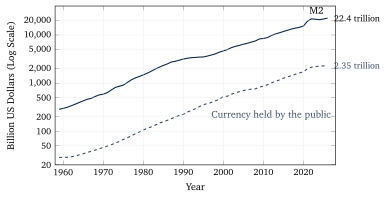
The proportions are what matter for the rest of the unit. In January 2026 the M2 money stock of the United States was 22.4 trillion dollars, and the notes and coins in circulation were 2.35 trillion dollars, about 10 per cent of it. The remaining 90 per cent was promises in the books of banks and funds. For the United Kingdom, the Bank of England, the central bank of the United Kingdom, put the share of deposits in broad money at 97 per cent in a 2014 explainer, and in every rich economy the figure is well over 90 per cent. Figure 1 shows the two layers since 1959 on a logarithmic scale, on which, as Unit 1 explained, equal vertical distances mean equal ratios. The two lines keep nearly the same distance apart, so cash has stayed between 7 and 11 per cent of the whole since 1959. About nine tenths of the money of a modern economy is bank money, and how a bank’s books come to contain it is the subject of Section 3.