 Image: Kaihsu Tai, public domain
An economy made of water
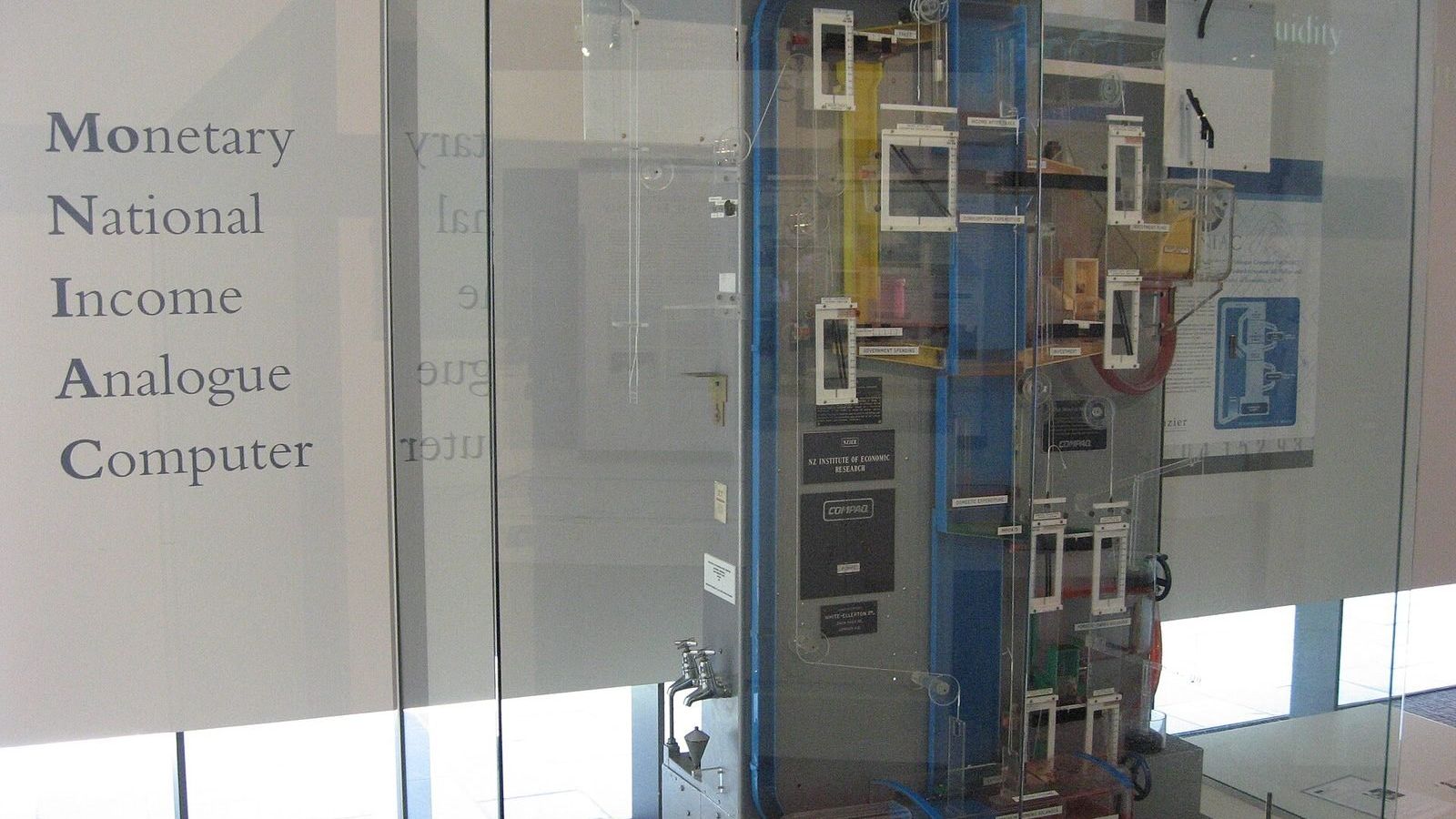
On 29 November 1949 a group of economists at the London School of Economics watched water flow through a contraption about two metres tall. Coloured liquid poured from a tank at the top labelled national income, split into streams for taxes, saving, and imports, collected in tanks for government spending and investment, and returned to the top through a pump. When a lever marked tax rate was moved, the flows changed, and a pen on the side traced the new path of national income on a roll of paper. The machine had been built in a garage in Croydon by a 35-year-old student who had taken one economics course, and it worked.
The builder
Alban William Housego Phillips was born in 1914 on a dairy farm in New Zealand. He left school at fifteen, worked as an apprentice electrician and in a gold mine in Australia, travelled across the Soviet Union and China, and qualified as an electrical engineer by correspondence. When the Second World War began he joined the Royal Air Force, was sent to Singapore, and spent three and a half years in Japanese prisoner-of-war camps, where he built a secret radio and a water heater from scrap. After the war he enrolled at the London School of Economics to study sociology, found economics more interesting, and found the way it was taught frustrating. Economists described the economy with systems of equations that most of them could not solve. Phillips, who could solve differential equations with electrical circuits, thought that the same could be done with water.
He built the first machine with Walter Newlyn, a fellow student, for about 400 pounds, which is around 15,000 pounds in today's money by the consumer price index. The demonstration of November 1949 earned him a teaching post at the school, and by 1958 he was a full professor. That year he published the paper on wages and unemployment in the United Kingdom from 1861 to 1957 that gave the Phillips curve its name. He is one of very few people to have an important machine and an important curve named after him.
What the tanks stand for
The machine's formal name was the Monetary National Income Analogue Computer, MONIAC for short, and the word analogue is the point. A digital computer represents a quantity by a number; an analogue computer represents it by a physical quantity that obeys the same equations. In the MONIAC, a stock of money is the volume of water in a tank, and a flow of spending is the rate at which water runs through a pipe. The circular flow of income that Unit 7 of the masterclass draws as arrows on paper is, in the machine, a literal circuit of water.
National income enters at the top. A valve controlled by a curved plastic slide takes a share of it as taxes, and the shape of the slide is the tax schedule. Another slide takes saving as a function of income, and a third takes imports. What remains is consumption, which flows down to join investment, government spending, and exports in a tank at the bottom, from which a pump returns the total to the top as the next round of income. The machine therefore contains the identity that output equals consumption plus investment plus government spending plus net exports, and the behavioural relations that make consumption and imports depend on income. A float in the tank that holds idle money balances is linked to the interest rate, and the interest rate in turn moves the valve for investment. That is a liquidity preference schedule and an investment demand schedule, the two relations at the heart of the Keynesian model of the 1940s.
The worked number that the machine was built to show is the multiplier. If the government opens the spending valve a little, the extra water goes round the circuit, and on each pass a fraction leaks out into taxes, saving, and imports. With a tax rate of 20 per cent, a saving rate of 10 per cent of disposable income, and imports of 10 per cent of income, about 36 per cent of each round leaks away and 64 per cent comes back. The sum of the rounds is 1 divided by 0.36, which is a little under 2.8. On the machine you could watch the level in the income tank rise over a minute or two and settle at a new height, with the overshoot and the slow approach that the equations predict and that a static diagram cannot show. Phillips claimed an accuracy of about 2 per cent, which was better than the data he was putting in.
Who used it
About twelve to fourteen machines were built, the exact count depending on how one treats the prototypes. The London School of Economics kept one, Cambridge and Oxford had them, and others went to universities in Manchester, Birmingham, Melbourne, and Istanbul. The Ford Motor Company bought one, and so did the Central Bank of Guatemala. Two machines could be connected to show two trading economies, with the exports of one becoming the imports of the other. The machines were used for teaching more than for forecasting, which was the sensible choice, because they simulated the structure of a model exactly and the structure of the British economy only roughly.
They were superseded within a decade. By the late 1950s electronic computers could solve the same equations faster and without leaks, and most of the machines were put in storage, where the perspex yellowed and the pumps seized. Several have since been restored. The machine at the Reserve Bank of New Zealand in Wellington runs, and the bank keeps it in its museum as a tribute to its most famous countryman in the field. The machine of the Faculty of Economics at Cambridge was restored in the 1990s and is run for students once a year or so. The Science Museum in London holds one of the two original machines from the London School of Economics, and its collection record can be searched online.
Why it still matters
The MONIAC is more than a curiosity. It makes visible three ideas that students find hard on paper. The first is the difference between a stock and a flow: a tank is a stock, a pipe is a flow, and the two cannot be added. The second is that an economy is a system of simultaneous relations, in which a change anywhere moves everything, and the final position is found by letting the system settle rather than by reading one equation. The third is the multiplier as a process in time, with its leakages, which is the subject of the Derivation box on the spending multiplier in Unit 10 of the masterclass. The same unit has an excursion on Phillips, the curve of 1958, and the way the relation between inflation and unemployment that he drew broke down in the 1970s.
Phillips himself moved on. He spent the 1960s on the mathematics of stabilization policy and on the economy of China, learned Chinese, and after a stroke in 1969 returned to New Zealand, where he died in 1975 at the age of sixty. The machine in the garage remains the best teaching device for a model of the economy that anyone has built, and it is worth the trip to see one run.