 Image: Jan Brueghel the Younger, public domain
Was tulip mania really a bubble?
The story goes like this. In the Dutch Republic of the 1630s, a craze for tulips drove the price of a single bulb to the value of a canal house in Amsterdam, chimney sweeps and servants gambled their savings on bulbs they never saw, and when the market collapsed in February 1637 the country was ruined and sober Holland learned something it never forgot. The story appears in Charles Mackay's Extraordinary Popular Delusions and the Madness of Crowds of 1841, and from there in a hundred books on finance, usually in the first chapter, as the first recorded bubble.
Anne Goldgar, a historian then at King's College London, spent years in the archives of Haarlem, Amsterdam, and Alkmaar reading notarial records, court cases, and the account books of the people who actually traded. Her book Tulipmania (University of Chicago Press, 2007) kept the collapse and threw out most of the rest. She has summarized the findings in a short article that is the best place to start.
What the archives show
Tulips came to Europe from the Ottoman Empire in the sixteenth century and became a collector's flower among wealthy Dutch townsmen. The most prized bulbs produced flowers with flamed and feathered petals, which we now know are the symptom of a virus spread by aphids; the variety called Semper Augustus, red flames on white, was the most famous of all. Such a bulb was rare because a virus-infected plant produces few offsets, and rare things were expensive. Prices in the hundreds of guilders for a single bulb are documented from the 1620s, long before the mania, and a few thousand guilders for the very rarest. A skilled craftsman in Haarlem earned about 300 guilders a year, so the top prices were real money, comparable to a modest house in a provincial town rather than a mansion on an Amsterdam canal.
What changed in 1636 was the way bulbs were traded. Bulbs are in the ground from autumn to June, so a trade in winter was a promise to deliver in summer, and the promises began to change hands many times before the bulb came up. The trading moved into taverns, among groups called colleges, with their own rituals and small fees, and ordinary bulbs that had been worth a few guilders began to sell by the pound for tens and then hundreds. The highest documented price Goldgar found for a single bulb was 5,200 guilders. Then, at an auction in Haarlem in the first days of February 1637, the bulbs failed to find buyers at the asking prices, the news travelled, and within a week the trade stopped. Nobody paid for what they had promised to buy, and the question of who owed what to whom went to the courts and the city councils, which eventually let the contracts be settled for a few per cent of the agreed price or cancelled them outright.
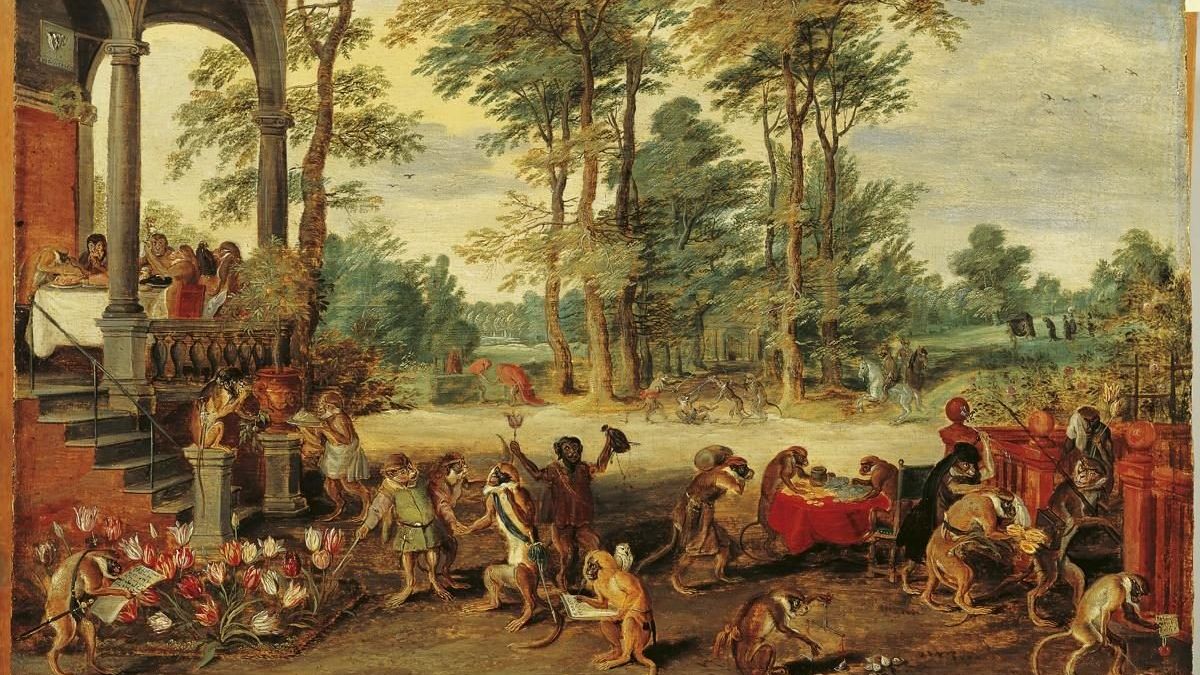
Goldgar found no evidence of the ruin the legend requires. She identified only 37 people who had spent more than 300 guilders on bulbs, most of them prosperous merchants and craftsmen who could afford the loss. She found no bankruptcy that could be traced to tulips, no economic downturn, and none of the suicides that Mackay's version of the story includes. The chimney sweeps and maids do not appear in the records. The people who did lose were mostly people who had sold a bulb and were never paid, and the sums were a sore point in a dozen families rather than a national catastrophe. Mackay, writing two centuries later, had copied his anecdotes from pamphlets that Dutch moralists wrote in 1637 to mock the trade, which were satire rather than reporting. Jan Brueghel the Younger painted the traders as monkeys in the picture at the top of this page at around the same time and for the same reason.
So was it a bubble?
It depends on the definition, and the definition is where the economics is. A bubble, in the sense that Unit 16 of the masterclass uses, is an asset price that rises above any value the asset's future payments could justify, carried by the expectation of selling to someone else at a higher price, and that then falls when the expectation fails. By that definition the tavern trade of the winter of 1636 to 1637 qualifies. Common bulbs that would always be common were changing hands at prices that only made sense if the next buyer would pay more, and the collapse came when the next buyer did not appear. What the archives correct is the scale and the consequences, and these matter for a different question: whether a bubble in one asset can bring down an economy. The tulip episode says nothing about that, because the asset was small, the traders were few, and the contracts were mostly never settled.
The economist Peter Garber argued in 1989 that even the prices were less mad than they look, since a rare bulb is a breeding stock whose offsets can be sold for years, in the way that a prize bull is. That explains the prices of the rare varieties in the 1620s well enough; it explains the tavern prices of common bulbs in January 1637 poorly, and Garber himself conceded as much. The honest summary is that the top of the market was a real bubble in a small market, that it was over in a week, and that it hurt almost nobody.
A worked number
The Semper Augustus is a good way to get a feel for the money. A price of 5,000 guilders was quoted for one bulb around 1633 and again during the mania, though it is not certain that a bulb changed hands at that price. At 300 guilders a year for a skilled craftsman, that is about seventeen years of wages. Today a skilled tradesperson in the Netherlands earns of the order of 45,000 euros a year, so the equivalent sum is in the region of 750,000 euros, which buys a good house in most Dutch cities and no canal house in central Amsterdam. For the common bulbs that made up the bulk of the tavern trade, prices of a few hundred guilders per pound were recorded for varieties that had sold for a guilder or two a few months before, which is a rise of a hundredfold and the clearest sign that something other than horticulture was going on.
What to take from it
Three points survive the revision. First, check the source. A story repeated in a hundred textbooks can still rest on one satirical pamphlet, and the only way to know is to find the records, which is what Goldgar did and what Unit 1 of the masterclass asks of every number. Second, the mechanics of the tavern trade are the mechanics of every later bubble: an asset with an uncertain fundamental value, a new way of trading that admits new participants, a rising price that recruits more buyers because it is rising, and a sudden halt. Unit 16 sets the stages out as Charles Kindleberger and Hyman Minsky described them and applies them to 1720, 1929, 2000, and 2006. Third, the damage a bubble does depends on who holds the asset and with whose money. The tulip traders were playing with promises among themselves. The house buyers of 2006 were playing with bank loans, and when their prices fell, the banks fell with them.
The painting at the top of this page, Brueghel's Satire on Tulip Mania of about 1640, is the hero image of Unit 16, and the watercolour of the Semper Augustus from the same century appears in the unit's excursion on the episode. Both are in the public domain and both are worth a long look.