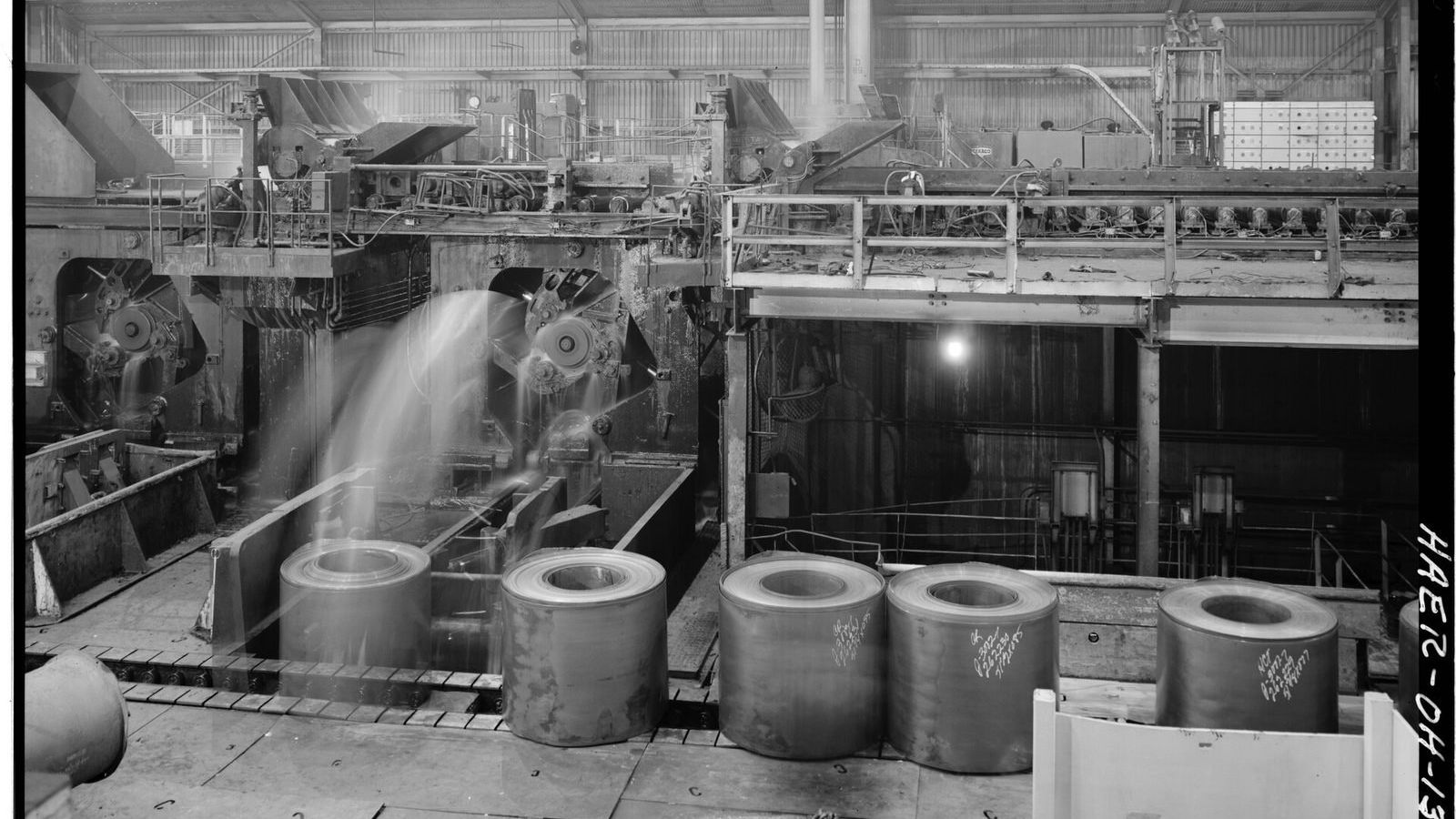
 Image: Historic American Engineering Record, Library of Congress, public domain
Who pays a tariff? The 2018 evidence
On 23 March 2018 the United States imposed a tariff of 25 per cent on imported steel and 10 per cent on imported aluminium, under a provision of trade law called Section 232. Over the following eighteen months it added tariffs of 10 to 25 per cent on about 350 billion dollars of imports from China, and China, the European Union, Canada, and others answered with tariffs on American goods. For economists it was a rare opportunity: a large, sudden change in a tax whose incidence the textbook describes in one diagram, applied to an economy whose prices are measured monthly down to the individual product. Within two years the studies were in, and they agreed.
The diagram
A tariff is a tax on an imported item, and the analysis of who pays a tax applies to it without change. The question is how much of the tariff shows up in the price the importer pays, and how much is absorbed by the foreign exporter through a lower price before tax. If the importing country is a small buyer in a world market, so that the foreign supply it faces is very elastic, the exporter has no reason to cut its price and the tariff is paid in full by the importer, which passes it on to its customers according to the elasticities of its own market. If the importing country is a large buyer, its tariff reduces world demand enough to lower the world price, and part of the burden is shifted abroad. Unit 11 of the masterclass draws both cases. The United States is the largest importer in the world, so the second case was a live possibility, and the claim that China would pay was not absurd in principle. It was an empirical question.
What the studies found
Mary Amiti, Stephen Redding, and David Weinstein used the monthly customs records of the United States, which record the value and quantity of every product imported from every country, to compare the prices of goods that were hit by tariffs with the prices of goods that were not, before and after each tariff took effect. Their paper in the Journal of Economic Perspectives in 2019 found that the prices foreign exporters charged, before the tariff, did not fall. The pass-through to the price paid by American importers was complete, close to 100 per cent, within months. By the end of 2018 the tariffs were costing American buyers about 3 billion dollars a month in additional tax and about 1.4 billion dollars a month in deadweight loss, the value of trade that no longer happened because it had been taxed out of existence.
Pablo Fajgelbaum, Pinelopi Goldberg, Patrick Kennedy, and Amit Khandelwal did the same exercise with a different method and a fuller model in a paper published in the Quarterly Journal of Economics in 2020, available as an NBER working paper. They also found complete pass-through to import prices. Adding up the losses to consumers and firms that bought imports, the gains to domestic producers who could raise their prices behind the tariff wall, and the tariff revenue collected by the government, they estimated the net cost to the United States in 2018 at about 7 billion dollars, or 0.04 per cent of GDP, with the losses concentrated in counties whose exports were hit by foreign retaliation. Economists at the Federal Reserve Bank of New York put the cost of the 2019 round of tariffs on China at about 830 dollars a year for a typical American household, counting both the tax and the deadweight loss.
A later study by Alberto Cavallo and co-authors, using retail prices scraped from the websites of large American shops, added a wrinkle. The tariffs on Chinese goods were passed fully to the prices importers paid at the border, as the other studies found, and only partly to the prices on the shelves, at least in the first year. The retailers absorbed part of the increase in their margins. Who pays therefore depends on where in the chain you look: foreign exporters paid almost nothing, American importers paid almost all of it, and the split between retailers and consumers was still working itself out when the studies were written.
Why foreigners did not pay
The explanation is the elasticities. For most of the products concerned, the United States was a large buyer but the foreign sellers had other markets, could switch output to them, and faced costs that did not fall because one customer had imposed a tax. In the terms of the tax incidence formula, the foreign supply elasticity was high relative to American import demand, so the burden fell on the demand side. The exceptions were a few products, such as some steel grades, where American buyers had few alternatives and foreign sellers had few customers; there, and only there, some of the burden shifted abroad. The theory did not fail; the condition under which the large-country case applies turned out not to hold for most goods.
A worked number
Take a steel coil imported at 800 dollars a tonne before the tariff. A 25 per cent tariff with complete pass-through raises the importer's cost to 1,000 dollars, and the price of domestic steel, which no longer has to compete with 800-dollar imports, rises towards the same level. The United States used about 100 million tonnes of steel a year, of which roughly a quarter was imported. If the domestic price rose by 150 dollars a tonne, which is roughly what happened in 2018, the extra cost to American steel users was of the order of 15 billion dollars a year, of which about 5 billion was tariff revenue on the imported quarter and 10 billion was a transfer from steel users to domestic steel producers. The steel industry employed about 140,000 people and the industries that use steel, from car makers to canneries, about forty times as many, which is why the studies of the steel tariff found that it saved jobs in steel and cost more jobs elsewhere.
What this does and does not settle
The incidence of a tariff is one question and the merits of a tariff are another. A government may impose one for reasons that have nothing to do with who pays: to retaliate, to protect an industry it considers strategic, to bargain. The 2018 evidence settles the narrower question, and it settles it against the claim that the tax falls on the exporting country. Unit 11 of the masterclass, International Trade and Exchange Rates, draws the tariff diagram, works through the 2018 steel case with the published pass-through estimates, and presents in its research spotlight the work of David Autor and his co-authors on what the rise of Chinese imports did to American local labour markets, which is the deeper issue the tariffs were a response to. The Atlas of Economic Complexity, the unit's weekly dataset, shows what every country exports to every other, and makes the elasticities easier to believe.