 Image: Mediatrotter, CC BY-SA 4.0
Why Austria has organ donors and Germany does not
In 2003 Eric Johnson and Daniel Goldstein published a one-page paper in Science with a bar chart that has been reproduced in every behavioural economics course since. It showed the share of adults in eleven European countries who were counted as consenting to organ donation. Four countries were at the bottom: Denmark at 4 per cent, the Netherlands at 28 per cent, the United Kingdom at 17 per cent, and Germany at 12 per cent. Seven were at the top, all above 85 per cent and most above 99: Austria, Belgium, France, Hungary, Poland, Portugal, and Sweden. The two groups did not differ in religion, wealth, education, or the rate at which people said in surveys that they approved of donation. They differed in the form.
Opt in or opt out
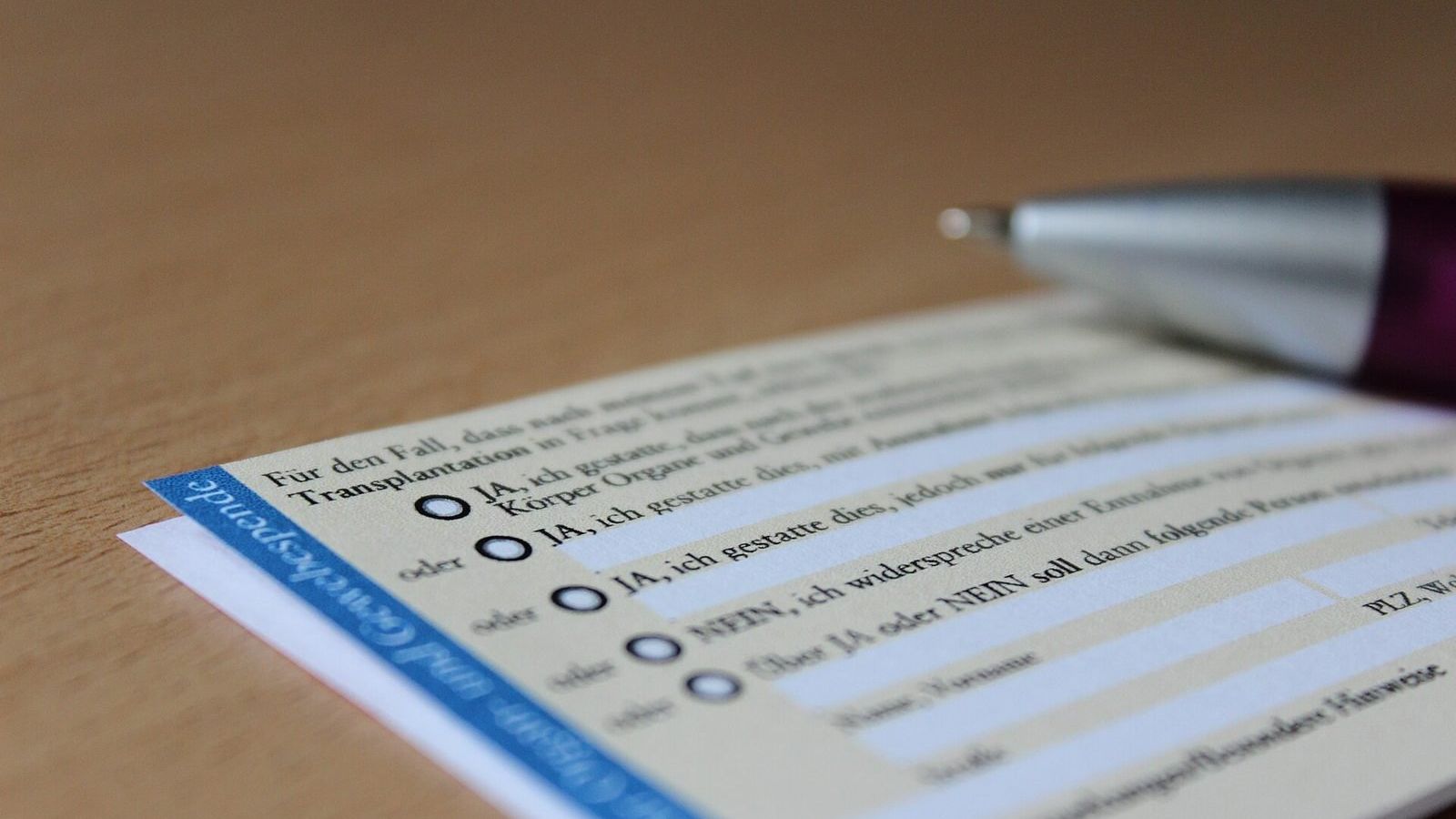
In the four countries at the bottom, a person who wanted to be a donor had to say so, by ticking a box or carrying a card. In the seven at the top, everyone was a donor unless they said they did not want to be, which also took a tick or a letter. Economists call the first arrangement opt-in and the second opt-out, and the setting that applies to a person who does nothing is the default. In the standard model of choice, which assumes that people hold a preference and act on it, the default should hardly matter, since the cost of a tick is trivial next to a decision about one's own body. In the data the default decided the outcome for almost everyone.
Johnson and Goldstein checked that the pattern was not an accident of history with an online experiment. They asked 161 people to imagine moving to a new state and to decide whether to be donors. One group was told the default was not to be a donor and could opt in; 42 per cent chose to donate. A second group was told the default was to be a donor and could opt out; 82 per cent remained donors. A third group was given no default and had to choose; 79 per cent chose to donate. The neutral condition was close to the opt-out one, which suggests that most people, when made to decide, want to donate, and that the opt-in form was recording a failure to act rather than a decision against.
Why defaults are so powerful
Unit 15 of the masterclass gives three reasons, and they reinforce each other. The first is effort. Changing a default takes a small action at an inconvenient moment, and present bias, the tendency to put off a small cost today even for a larger benefit later, means the action is postponed indefinitely. The second is loss aversion, from Unit 14. Whatever the default is becomes the reference point, and leaving it feels like giving something up. The third is that a default carries information. People reasonably assume that the option the authority has chosen for them is the recommended one, or at least a normal one, and in a decision that is unpleasant to think about, the recommendation is accepted and the thinking avoided.
The same three forces explain the better-known default results in finance. When an American firm studied by Brigitte Madrian and Dennis Shea in 2001 switched its pension plan from opt-in to automatic enrolment, participation among new employees jumped from about half to about 85 per cent, and most of the newly enrolled stayed at the default contribution rate and in the default fund for years. Richard Thaler and Shlomo Benartzi's Save More Tomorrow plan, which asks workers to commit in advance to raising their contribution at each future pay rise, took the average contribution rate of its first group from 3.5 to 13.6 per cent in under four years. The United Kingdom's automatic enrolment of 2012 raised workplace pension participation by millions. Thaler's Nobel lecture of 2017 tells the story of how these results turned a list of anomalies into a policy tool, and the research spotlight of Unit 15 presents David Laibson's work with Madrian and others on what retirement defaults do.
What the default does not do
A careful reader will have noticed that the chart shows consent rates, which are a legal status, and that what matters to a patient on a waiting list is the number of organs transplanted. The two are related and far from identical. Spain, which has had an opt-out law since 1979, leads the world in deceased donations per million people, at around 45 to 50 in recent years, and Spanish transplant coordinators attribute most of that to the organization of hospitals, the training of intensive care staff, and the way families are approached, rather than to the law. Sweden has opt-out consent and a donation rate below the European average. Germany, with opt-in, has one of the lowest rates in western Europe, and the Bundestag debated switching to opt-out in January 2020 and voted against it, choosing instead to ask people the question when they renew identity documents. England moved to opt-out in May 2020 and the Netherlands in July 2020, and the early evidence is that donation rose modestly rather than dramatically, in part because families are still consulted and in part because the binding constraint is the small number of deaths in circumstances that allow donation. The default moves the consent rate enormously and the transplant rate somewhat, and an honest account says both.
A worked number
Suppose a country of 10 million people has a consent rate of 15 per cent under opt-in and would have 90 per cent under opt-out, as the Johnson and Goldstein figures suggest. About 1 person in 1,000 dies each year in a hospital in a way that makes donation medically possible, which is roughly 10,000 potential donors. If the family's decision followed the registered status in every case, opt-in would yield 1,500 donors and opt-out 9,000. In reality families override in both directions, hospitals miss potential donors, and a large share of registered donors die in ways that rule out donation, so the realized numbers in European countries are in the range of 150 to 500 deceased donors a year for a country that size. The gap between the arithmetic and the reality is the subject of transplant medicine rather than economics, and it is the reason the Spanish numbers are what they are.
The ethics of the default
Someone has to choose the default, and the choice has consequences, so there is no neutral option; this is the argument Thaler and Cass Sunstein made in 2008 for what they called libertarian paternalism, the design of defaults that serve people's own goals while leaving them free to choose otherwise. The objections are also serious. A default works on people who are inattentive, and these are often the people least able to afford a wrong default, so a pension plan that defaults workers into a high-fee fund does harm with the same force that a good default does good. A default on a matter as personal as the body can be experienced as a presumption, which is part of why Germany declined it. And a default that works too well can let a government avoid the harder work of persuasion and organization that produces the Spanish result. Unit 15 sets out the definition of a nudge, the evidence on how large nudge effects are once the published studies are corrected for publication bias, and the cautions that Thaler himself attaches to the tool, so that a student can form a view of their own.